How Much Should a 10–100 Employee Business Spend on Digital Marketing in 2026?
The If your business has between 10 and 100 employees, you have probably reached a point where marketing can no longer be something that happens only when someone has time.
Your website needs to generate enquiries. Your social media needs to demonstrate credibility. Your SEO needs to help potential customers find you. Your content needs to keep your business visible. And increasingly, your business needs to appear in AI-powered search tools such as ChatGPT and Google AI search.
But how much should you actually spend on digital marketing?
The honest answer is: there is no single percentage or monthly figure that works for every UK SME.
Your ideal digital marketing budget depends on your turnover, growth ambitions, customer value, sales cycle, competition, existing digital presence and whether you have marketing expertise in-house.
For an established 10–100 employee business, the more useful question isn’t:
“What percentage of revenue should I spend on marketing?”
It is:
“What level of marketing investment do I need to generate the growth I want?”
What is a realistic digital marketing budget for a UK SME?
You will find plenty of articles recommending a fixed percentage of revenue for marketing.
The problem is that many commonly quoted benchmarks come from much larger organisations and aren’t necessarily appropriate for an established UK SME.
Recent UK research has highlighted exactly this issue, with some marketing specialists warning against simply applying large-company marketing benchmarks to smaller businesses.
Instead, consider your marketing budget according to your business stage.
A business maintaining its current position
If your business already has a strong customer base and is primarily looking to maintain visibility, your marketing investment may be relatively modest.
Your priorities might include:
- Website maintenance
- Local and organic SEO
- Google Business Profile optimisation
- Social media
- Email marketing
- Customer retention
- Reviews and reputation management
- Regular website content
A business actively trying to grow
If you’re aiming to increase enquiries, enter new markets, recruit more customers or increase turnover, your marketing investment needs to be more substantial.
Your budget could include:
- Website improvements or redevelopment
- SEO strategy and implementation
- Local SEO
- AI search optimisation and GEO
- Content creation
- Social media management
- Google Ads or paid social
- Landing pages
- Email marketing
- Conversion rate optimisation
- Marketing automation
- Analytics and reporting
The key is not to spread a limited budget across every possible channel.
A focused £2,000 marketing investment can be more effective than a badly allocated £5,000 budget.
What should a 10–100 employee business actually spend its marketing budget on?
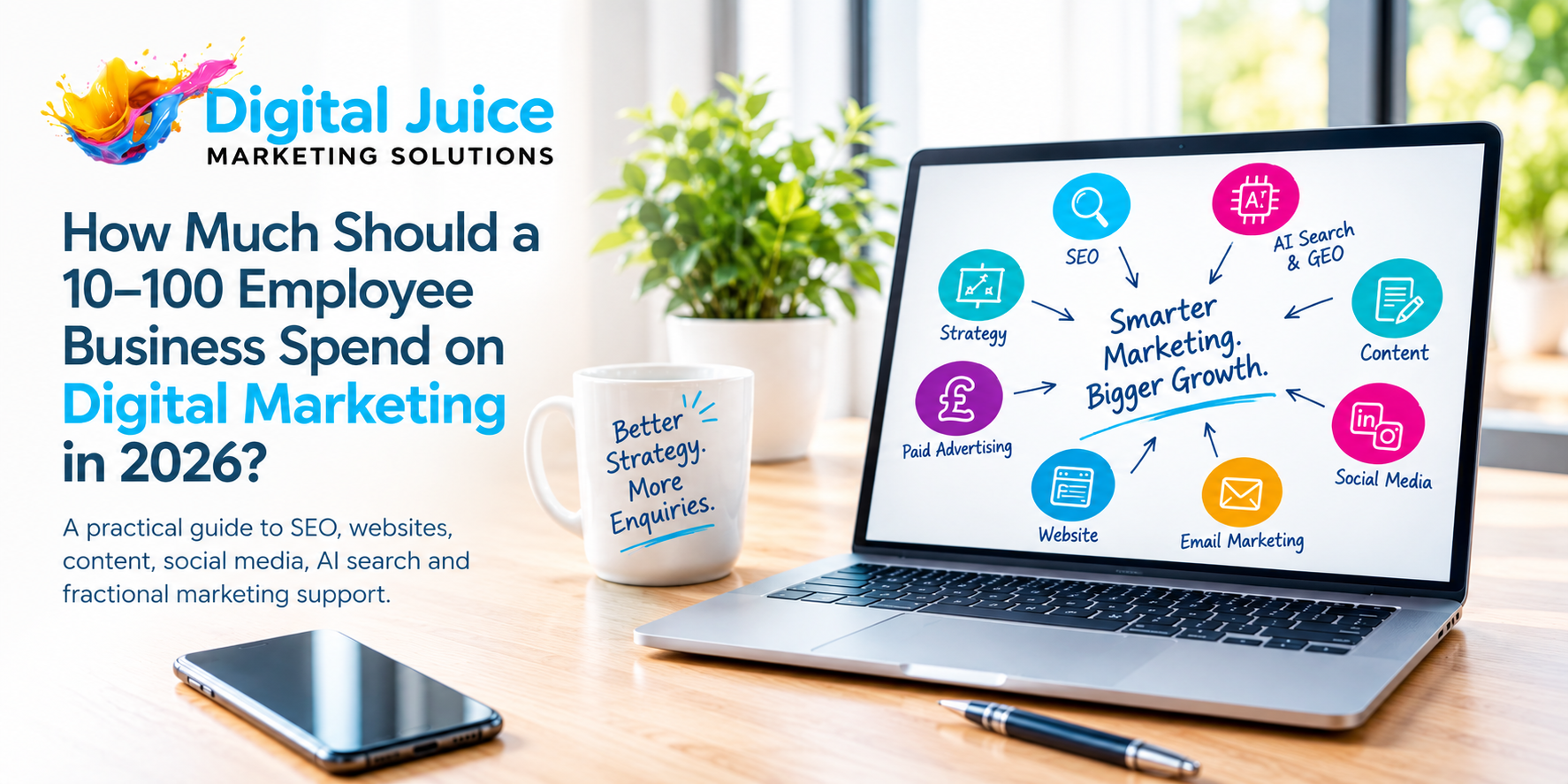
For an established SME, I would think about digital marketing as a system rather than a collection of unrelated services.
1. Your website
Your website is often the first serious interaction a potential customer has with your business.
If it looks dated, loads slowly, isn’t mobile-friendly or doesn’t clearly communicate why someone should contact you, increasing your traffic won’t necessarily increase your sales.
Your website should:
- Clearly explain what you do
- Demonstrate your expertise
- Build trust
- Target the right search terms
- Be easy to navigate
- Work properly on mobile
- Have clear calls to action
- Generate enquiries
- Support your SEO strategy
- Provide useful information that AI search engines can understand
A website isn’t simply an online brochure.
It is a marketing and sales asset.
2. SEO and Local SEO
SEO remains one of the most important long-term investments for businesses that depend on people finding them online.
For a Surrey or South East business, that may include targeting searches such as:
- digital marketing agency Surrey
- accountants in Croydon
- business consultants in Surrey
- commercial property services South East
- professional services Reigate
- marketing agency Caterham
The objective isn’t to rank for every keyword.
It is to become visible when the right potential customer is actively looking for what you sell.
Local SEO can also include:
- Google Business Profile optimisation
- Local landing pages
- Reviews
- Local citations
- Location-based content
- Structured data
- Consistent business information
- Local backlinks
3. AI Search and GEO
There is another layer to search that businesses can no longer afford to ignore.
Potential customers are increasingly asking AI platforms questions such as:
“What’s the best digital marketing agency in Surrey for an established SME?”
or:
“Who can help a 50-person business improve its SEO and website?”
Rather than simply returning ten blue links, AI-powered search can provide a direct answer and recommend businesses.
This is where Generative Engine Optimisation, or GEO, comes into the picture.
Your business needs to provide clear, authoritative and useful information that search engines and AI systems can understand.
That means creating content around the questions your ideal customers actually ask.
For example:
- How much does SEO cost in the UK?
- How much should an SME spend on digital marketing?
- Should I hire a marketing manager or an agency?
- How can my business appear in ChatGPT?
- How do I improve my Google visibility?
- What should my website include?
- How can I generate more B2B enquiries?
This is one reason I recommend treating SEO, content and AI search visibility as part of one connected strategy rather than three separate activities.
4. Content marketing
Content is no longer simply about writing blogs for the sake of having a blog.
Good content should answer your customers’ questions.
It should demonstrate expertise.
It should support SEO.
And increasingly, it should give AI search engines useful information about your business and your areas of expertise.
For an established SME, content could include:
- Blog articles
- Case studies
- Customer success stories
- Guides
- FAQs
- Videos
- LinkedIn content
- Instagram content
- Industry insights
- Service pages
- ·Location pages
The best content answers a question before your prospective customer needs to pick up the phone.
5. Social media
Social media should support your wider marketing strategy rather than exist in isolation.
For many established businesses, the question isn’t:
“How many followers do we have?”
It is:
“Does our social presence make a potential customer trust us?”
Your social channels should demonstrate:
- · Expertise
- · Experience
- · Personality
- · Customer results
- · Products and services
- · Behind-the-scenes activity
- · Client stories
- · Industry knowledge
For B2B businesses, LinkedIn may be particularly important.
For visual businesses, Instagram can play a much larger role.
The right channel depends on where your customers actually spend their attention.
6. Paid advertising
Paid advertising can accelerate results, but it shouldn’t be used to compensate for a poor website or unclear proposition.
Before increasing your Google Ads or Meta Ads budget, ask:
If I doubled my website traffic tomorrow, would my website convert those visitors?
If the answer is no, fixing the website and customer journey may be a better investment.
How much does a digital marketing agency cost in the UK?
Digital marketing agency costs vary considerably depending on the level of strategy, implementation and expertise involved.
A basic service may focus on one area such as social media or SEO.
A more comprehensive arrangement can include:
- Strategy
- SEO
- Website development
- Content
- Social media
- Paid advertising
- Analytics
- Conversion optimisation
- AI search optimisation
The important comparison isn’t simply the monthly fee.
Ask:
What am I actually getting for that investment?
A cheaper provider may give you activity without strategy.
A more expensive agency may provide a large team when you only need a small amount of senior expertise.
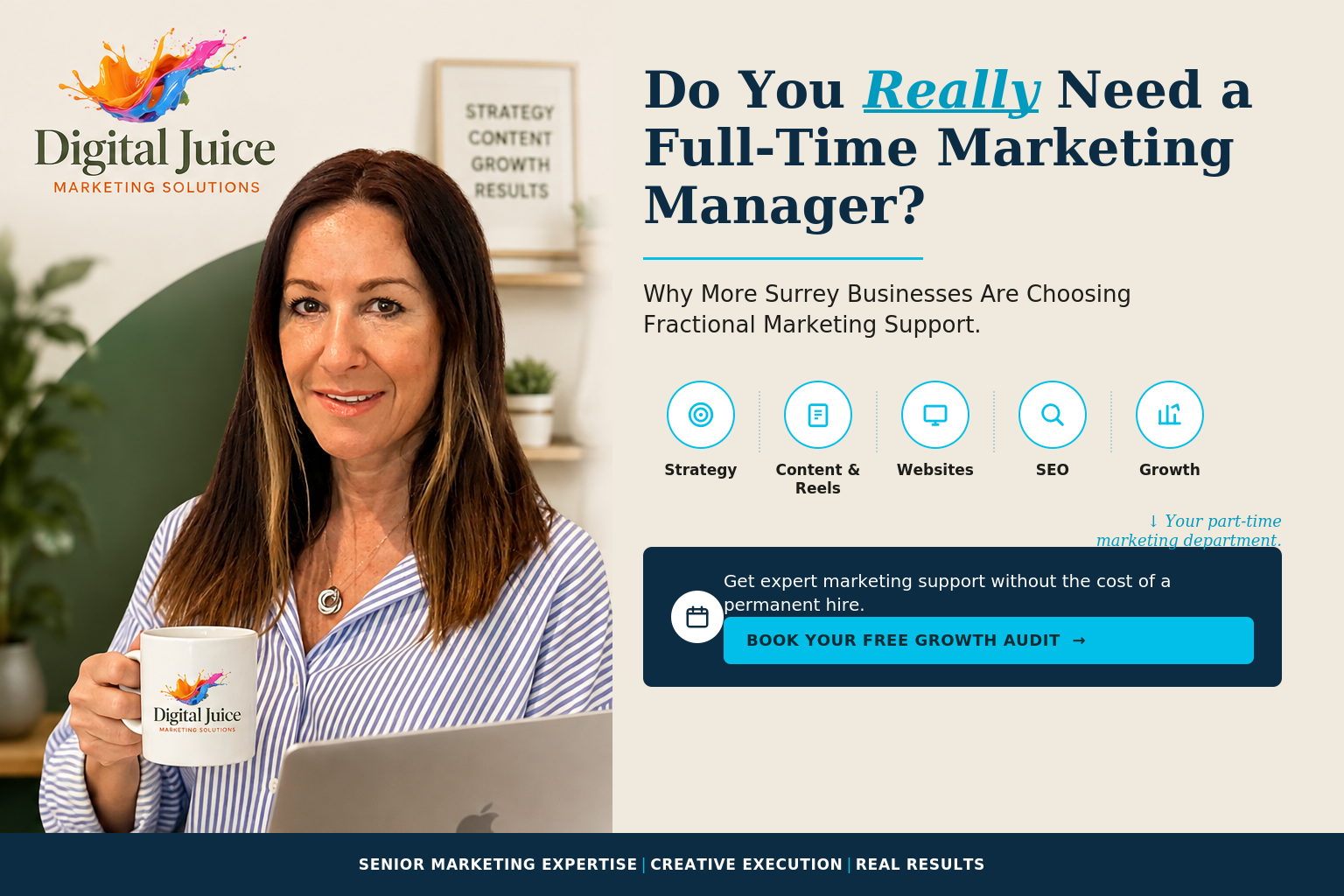
For an established SME, the sweet spot can sometimes be fractional marketing support.
Do you need a full-time marketing manager?
Not necessarily.
This is one of the biggest questions facing growing businesses.
A 10–100 employee company may need senior marketing expertise but not necessarily a full-time marketing department.
You could hire:
An employee
Best when you need someone working internally every day and you have enough marketing activity to justify the full employment cost.
A traditional agency
Best when you need a wider team of specialists and multiple marketing channels managed simultaneously.
A fractional marketing partner
Best when you need experienced strategic direction and practical marketing execution without the cost of employing a complete in-house team.
A fractional marketing model effectively gives you access to a part-time marketing department.
You get strategy, expertise and implementation without necessarily carrying the overhead of a full-time team.
What is fractional marketing?
Fractional marketing is where an experienced marketing professional or team works with your business on an ongoing part-time basis.
Instead of employing:
- · A marketing manager
- · SEO specialist
- · Social media manager
- · Content writer
- · Website specialist
- · Digital strategist
you can potentially access several of those capabilities through one marketing partner.
For an established SME, this can provide a flexible way to increase marketing capability without immediately building a full internal department.
At Digital Juice Marketing Solutions, this is exactly the type of support we provide.
We work with small and medium-sized businesses as a fractional 360° digital marketing partner, combining strategy with practical implementation. With more than 25 years of digital marketing experience, Digital Juice provides senior-level expertise without the overheads associated with a large agency or full-time marketing department.
What should a Surrey business spend on digital marketing?
For businesses across Surrey and the wider South East, the answer depends heavily on your objectives.
A local professional services company with 20 employees may need a very different strategy from a 75-person eCommerce business.
A business targeting customers in:
- · Croydon
- · Coulsdon
- · Purley
- · Caterham
- · Banstead
- · Reigate
- · Epsom
- · Kingston
- · Redhill
- · Bromley
- · Surrey
- · Kent
- · Sussex
may also need a stronger local SEO strategy than a company selling nationally.
Rather than selecting a marketing budget because another business spends a certain percentage of revenue, start with your commercial objectives.
Ask:
How many additional customers do we want?
What is an average customer worth to us?
How many enquiries do we need to generate those customers?
What conversion rate do we currently achieve?
Which marketing channels are already producing results?
Where are we currently losing potential customers?
Those answers give you a much more meaningful marketing budget.
Why your marketing budget could be wasted
One of the biggest mistakes businesses make isn’t necessarily spending too little.
It is spending without a strategy.
For example, imagine a business spending:
£1,000 on social media
£1,000 on Google Ads
£1,000 on SEO
£500 on content
£500 on website updates
That sounds like a £4,000 monthly marketing investment.
But what if none of those activities are connected?
Your SEO targets the wrong keywords.
Your website doesn’t convert visitors.
Your social media isn’t aimed at your ideal customer.
Your advertising sends traffic to a weak landing page.
Your content answers questions nobody is asking.
You’ve spent £4,000.
But you haven’t necessarily built a marketing system.
Strategy should come before activity.
What does a good SME digital marketing strategy look like?
For an established business, your marketing should create a connected journey:
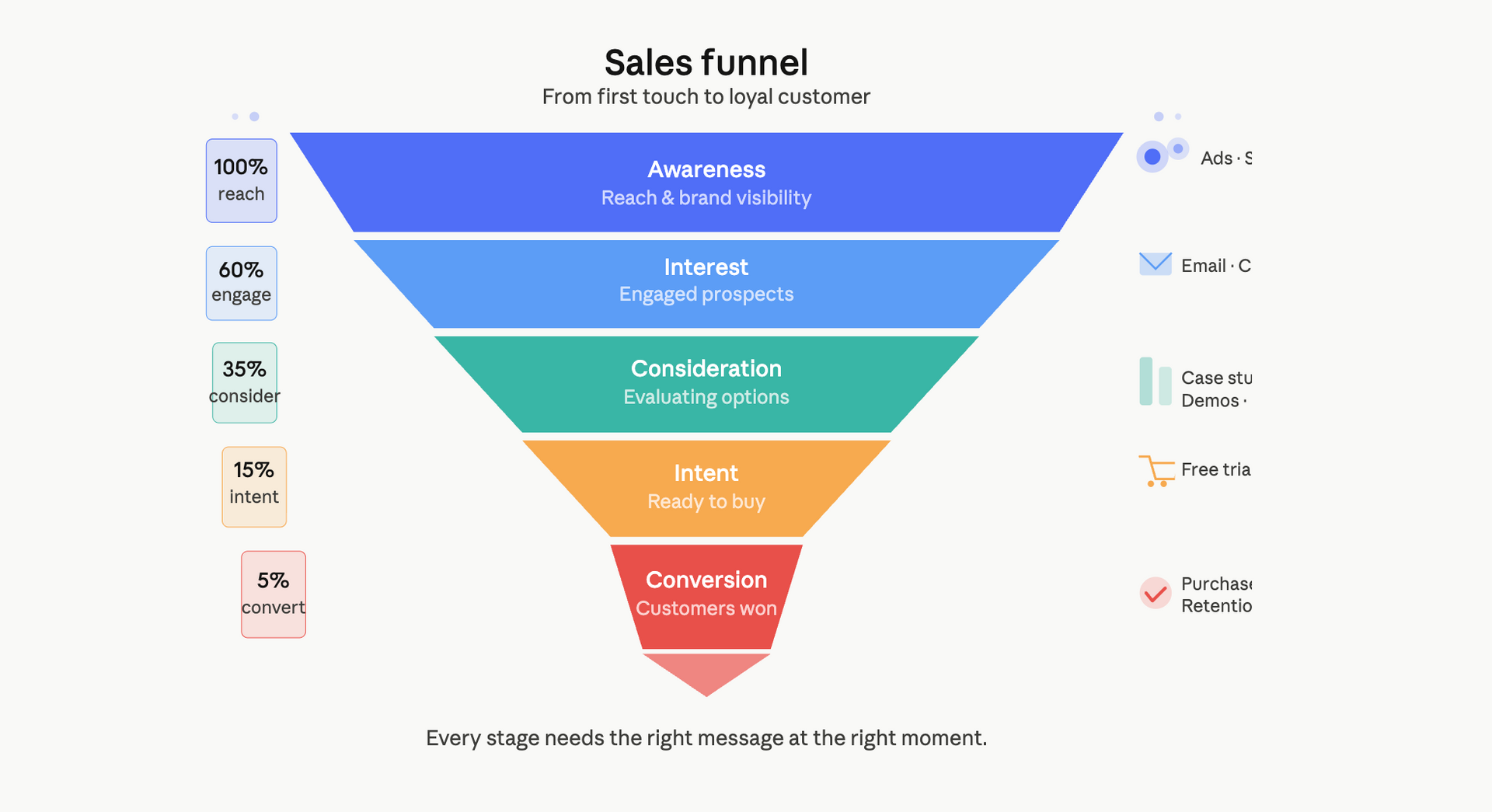
SEARCH → WEBSITE → TRUST → ENQUIRY → SALE → RETENTION
Your potential customer might first discover you through Google.
They may then visit your website.
They may look at your LinkedIn profile.
They may read a case study.
They may check your reviews.
They may ask ChatGPT about your business or your industry.
They may follow you on social media.
Eventually, they contact you.
Every part of that journey contributes to whether they trust you enough to buy.
That is why digital marketing shouldn’t be treated as six separate services.
Your website, SEO, content, social media, paid advertising and AI search visibility all need to work together.
How do you decide your digital marketing budget?
Before setting your budget, answer these eight questions:
1. What are our business growth goals?
Do you want more leads, more customers, higher average order values or entry into a new market?
2. Who is our ideal customer?
Be specific.
Industry, location, company size, decision-maker and buying behaviour all matter.
3. What is a new customer worth?
Understanding customer value helps you determine how much you can reasonably invest in acquisition.
4. Where are our customers searching?
Google?
LinkedIn?
Instagram?
Industry directories?
AI search?
Your answer should influence where you invest.
5. Is our website converting?
Traffic without conversions isn’t growth.
6. Can our existing team execute the strategy?
If nobody has the time or expertise, you may need external support.
7. Do we need specialists or strategic leadership?
You may not need five different suppliers.
You may need one experienced person coordinating the whole digital strategy.
8. How will we measure success?
Your marketing should ultimately connect activity with commercial outcomes.
Look beyond likes and impressions.
Track:
- Qualified enquiries
- Leads
- Conversion rates
- Website enquiries
- Cost per lead
- Organic traffic
- Search visibility
- Local search visibility
- Customer acquisition cost
- Revenue generated
The bottom line
There isn’t one magic digital marketing budget for every UK SME.
The right investment depends on your business, your customers and your growth ambitions.
But if your company has reached 10–100 employees, there is a good chance that continuing to treat marketing as an occasional task is no longer enough.
You need a strategy.
You need consistent execution.
And you need someone responsible for joining all the pieces together.
That could mean building an internal marketing team.
It could mean working with a traditional digital marketing agency.
Or it could mean bringing in a fractional marketing partner who acts as your part-time marketing department.
The important thing is that your marketing investment should have a clear commercial purpose.
Need to know where your marketing budget is being wasted?
Digital Juice Marketing Solutions provides digital strategy, website development, SEO, social media, content and digital marketing support for established SMEs across Surrey and the South East.
We offer a FREE Digital Growth Audit to identify gaps across your website, SEO, online visibility, content and digital marketing.
You can then see exactly where your biggest opportunities are before deciding where to invest.
Book your free Digital Growth Audit with Digital Juice Marketing Solutions - 07859 815326, or email your enquiry to -> info@digitaljuicemartketing.co.uk.